U.S.–Israel control of major tech firms has converted digital systems into tools of impunity.
The dominance of U.S.-Israeli-linked technology firms has evolved into a structural system of power. A handful of companies, rooted in the United States yet operating globally, set the technical, normative and regulatory architecture of the internet. Their decisions affect the access, representation and voice of millions of people in the Global South and other less-powerful regions. The case of online censorship around the YouTube platform in relation to alleged abuses in Gaza and the occupied West Bank offers a concrete example of how this concentration of power translates into impunity, erasure of evidence, and distortion of accountability.
In early October 2025, YouTube deleted more than seven hundred videos and terminated the accounts of three prominent Palestinian human-rights organisations: Al-Haq, Al-Mezan Centre for Human Rights, and the Palestinian Centre for Human Rights. According to The Canary, the deleted material included eyewitness accounts of home demolitions in the West Bank, investigations into the killing of Palestinian-American journalist Shireen Abu Akleh by Israeli forces, and documentaries showing the plight of Gaza mothers whose children were killed (The Canary, 2025). YouTube attributed the removals to compliance with United States sanctions against the NGOs because of their cooperation with the International Criminal Court (ICC) investigation into alleged war crimes by Israeli officials (Anadolu Agency, 2025).
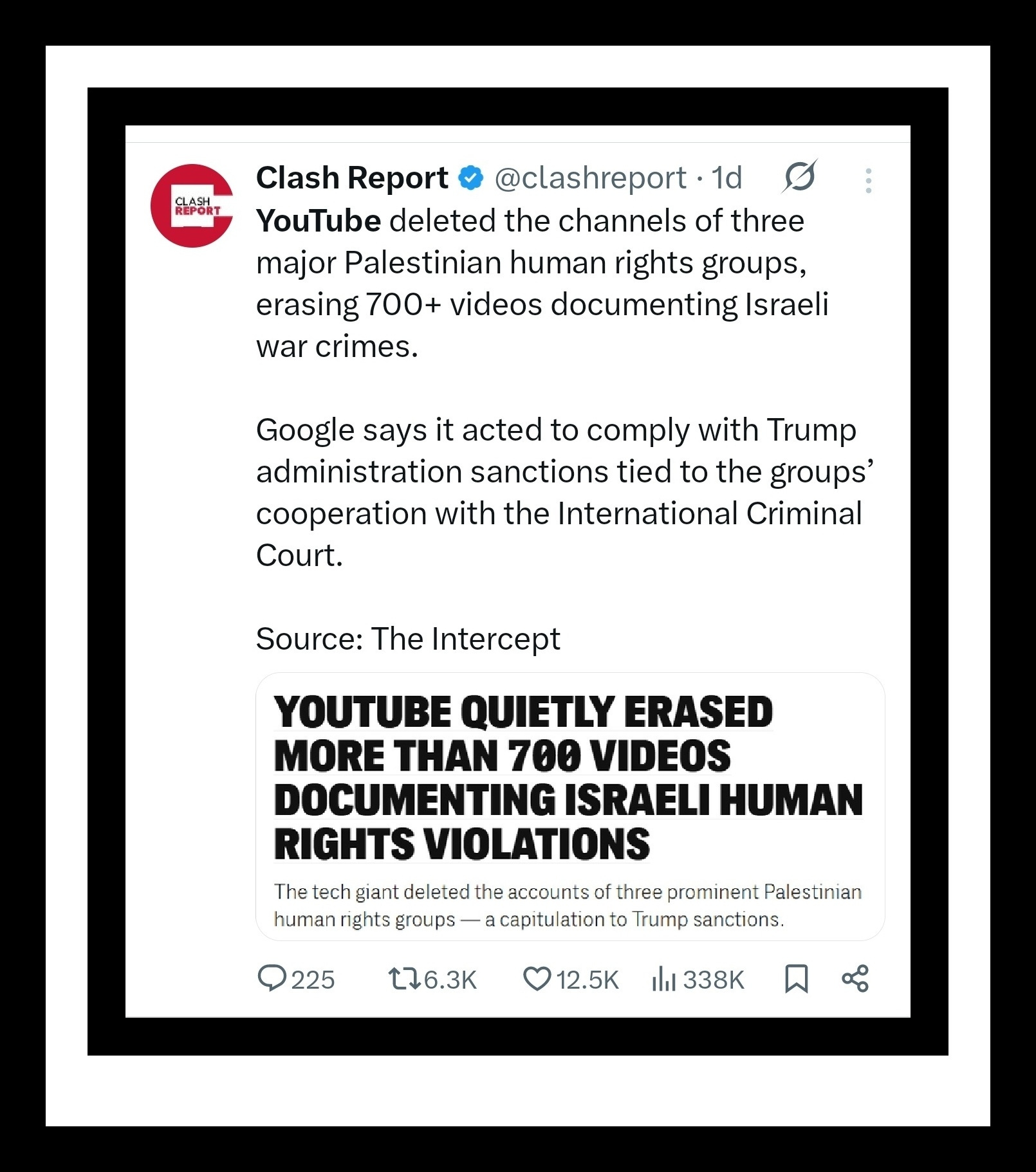
The pattern raises a core concern: when the architecture of the internet is controlled by a few dominant platforms aligned with U.S. foreign-policy priorities, the space for independent documentation, voice of the weak, and accountability for powerful states shrinks. A global internet under these conditions becomes an instrument of dominance, not a space of equal voice. Glenn Greenwald (2024) has argued that “U.S. big tech firms function as extensions of state power under the banner of national security and information hygiene,” a claim echoed by Max Blumenthal of The Grayzone, who describes the alliance between Silicon Valley and Western security agencies as “a digital arm of empire” (Blumenthal, 2023).
From the victims’ perspective, particularly those in the Global South or under occupation, decentralisation of the internet and technology is crucial. The ability to record, archive and distribute evidence of wrongdoing depends on access and independence of platforms not beholden to state or corporate sanctions. The removal of the channels of Al-Haq, Al-Mezan and PCHR effectively erased archival material that might have supported international legal processes, memory and redress. A human-rights actor cited by The Canary noted that “the internet is not durable for storing evidence… digital evidence is incredibly fragile” (The Canary, 2025). In a conflict where one side is significantly stronger militarily, economically and technologically, the asymmetry of voice and archiving becomes part of the power structure.
A broader technological architecture is implicated too: automated moderation systems, algorithms, terms of service and sanctions compliance are governed by U.S. law and corporate policy rather than by international human-rights frameworks. Research published on arXiv observed that YouTube comment moderation around the Israel–Palestine conflict showed a higher incidence of hate speech on public videos (40.4 per cent) than on private ones, and that moderation outcomes were politically charged because architecture itself shapes political discourse (Saleem et al., 2025). Similarly, Time Magazine reported that Arabic-language and Middle East content is more frequently removed by algorithmic moderation systems because extremist-content datasets are disproportionately trained on Arabic examples, leading to biased over-enforcement (Vogt, 2020). These findings confirm that platform governance is neither neutral nor evenly applied.
When a U.S.-linked firm such as Google (owner of YouTube) chooses to comply with sanctions by removing human-rights footage, the result is a chilling effect on accountability of states. As human-rights lawyer Katherine Gallagher of the Centre for Constitutional Rights stated, “it is outrageous that YouTube is furthering the U.S. government’s agenda to remove evidence of human rights violations and war crimes from public view” (International Business Times UK, 2025). Tech-dominance thus intersects with geopolitical power: a state that receives U.S. military and diplomatic support, Israel, benefits from a digital environment that suppresses scrutiny of its actions.
The implications for international law and justice are serious. The archival erasure of evidence weakens the ability of the ICC, tribunals and other supranational bodies to act. Dependence of global communication on a few U.S.-based firms means that supranational bodies such as the ICC, the United Nations or regional courts lack independent infrastructure to guarantee access, fairness and accountability. Without decentralised systems, global governance becomes mediated by the rules of private corporate platforms aligned with hegemonic states. As Craig Murray (2024) observed, “we now have the spectacle of a private company enforcing U.S. foreign policy through algorithmic censorship that directly impedes international justice.”
The dominance of these firms operates like organised power, capturing channels of _expression_, controlling narratives and suppressing unwanted voices. It is not merely a matter of free speech but of structural control, the ability to decide which events remain visible in the global record and which disappear. That dynamic shifts the balance of justice. For weaker parties, victims, civil society in the Global South and human-rights monitors, the imbalance means facing erasure not only on the ground but online. Jonathan Cook (2024) described this as “digital colonisation, where Palestinians are doubly occupied, first territorially, then digitally, through Silicon Valley’s compliance with Israeli and U.S. state objectives.”
The argument for multipolarity and decentralisation thus becomes urgent. A balanced global internet cannot rely on a handful of platforms operating under one state’s sanctions and foreign-policy framework. Distributed networks, independent archiving and guaranteed access beyond corporate terms are needed, along with regulatory architecture tied to international law rather than corporate policy. The Brazilian scholar Sérgio Amadeu da Silva has written extensively on colonialismo de dados, data colonialism, arguing that Western platforms act as new imperial infrastructures by extracting, filtering and controlling data from the Global South (da Silva, 2021). The YouTube case demonstrates this dynamic in practice: a U.S.-based company suppresses Palestinian rights content, aligning with a foreign-policy interest that arms and shields Israel while weaponising compliance rules against those who document its abuses.
Such digital colonialism entrenches dependency and undermines pluralism. Decentralisation, through federated networks, open-source platforms, community-run servers and blockchain-based archiving, offers a route towards digital self-determination. As researcher Michael Kwet (2023) of Yale University has noted, “digital colonialism is the control of the digital ecosystem by a small number of Western monopolies; liberation requires de-Westernising the internet and restoring local control.” Without such structural reform, supranational bodies and civil movements will remain hostage to decisions made in corporate boardrooms in California or Tel Aviv.
The link between digital suppression and physical violence must also be recognised. When footage and testimonies vanish from major platforms, the visibility of atrocities declines, reducing international pressure for accountability. This invisibility is not accidental, it is the product of compliance systems embedded in Western power structures. Israeli military operations, U.S. diplomatic shielding at the UN, and digital erasure form a continuum. As journalist Ramzy Baroud (2024) has argued, “the erasure of Palestinian suffering online mirrors the erasure of Palestine on the ground. Both are part of the same machinery of domination.” The absence of countervailing digital power ensures that the same hegemonic narrative dominates both the physical and informational domains.
The Murthy v. Missouri case in the United States, though dismissed on procedural grounds, revealed how federal agencies pressured Meta, Twitter and YouTube to suppress disfavoured opinions under the banner of countering misinformation (Responsible Statecraft, 2024). The unresolved constitutional question of state-platform coordination highlights the merger between public and private power in digital governance. When that merger operates globally, the result is a form of extraterritorial censorship: national policy exported through corporate compliance. Such coordination entrenches the global dominance of the U.S.-Israeli technological nexus.
These developments undermine the very notion of international law as an impartial arbiter. If evidence of war crimes can be removed by private firms on the pretext of sanctions compliance, the enforcement of international justice becomes selectively possible only where U.S. interests permit. This situation recalls the observation of scholar Richard Falk, former UN Special Rapporteur for Human Rights in Palestine, who wrote that “the hegemony of the United States over digital communication reinforces its geopolitical impunity; the result is an Orwellian inversion of justice” (Falk, 2023). In such an environment, supranational institutions must assert independence, develop their own digital infrastructure, and resist coercion by private intermediaries acting on behalf of hegemonic powers.
The call for decentralisation of the internet is not an abstract technological argument; it is a political and moral necessity. The centralisation of digital infrastructure in a few corporate hands enables not only censorship but data surveillance, manipulation of public perception, and enforcement of geopolitical hierarchies. Decentralisation offers the only route to restore pluralism, protect evidence, and ensure that victims and marginalised groups have independent means to tell their stories. The power of the weak lies in their ability to communicate; the monopoly of the strong lies in their ability to silence.
The removal of hundreds of videos documenting alleged Israeli war crimes thus symbolises the wider crisis of digital sovereignty. The victims’ testimonies, the human-rights footage and the evidence for international courts are not mere digital artefacts, they are the building blocks of justice. Their erasure by a corporation acting under the orders of a foreign government demonstrates the degree to which digital architecture has been captured by political power. Only through a decentralised, multipolar internet governed by international law and independent institutions can the global community prevent such erasure and begin to restore fairness and accountability.
The concentration of internet and technological power in the hands of a few oligarchic corporations has created a new form of imperial domination. For those subjected to aggression and marginalisation, the stakes are existential. The end of U.S. hegemonic control over digital infrastructure is a prerequisite for a fair and multipolar world where international law, human-rights norms and independent archives prevail over corporate-state impunity.
Authored By: Global GeoPolitics